


Stop journaling and waiting for something to change.
You scroll.
You journal.
You do the yearly reflection.
You’ve done the work.
But are you waiting for something to happen without your participation? Are you looking for someone else to tell you what to do?
You’ve got to do your part. You are responsible for finding meaning in your life (and work). No one is going to tell you what that is.
Try this and see how far you get: Write down your dreams and thoughts, but skip the part about how you’re going to get there. If you skip the commitment to practice change, how can you expect change?
Most people confuse reflection with change. They think if they write it down, they’ve done the work. They haven’t.
Here’s what’s actually happening: You’re using reflection as a mirror that only shows you what you already believe. Each entry validates the existing loop. You are creating a loop of perception and validating it again and again. You’re not reflecting, you’re reinforcing. Reflection without action is just validation.
The Cost of Not Practicing Change
If you keep this up, you’ll be in the same place a year from now. You are waiting for permission that never comes and are looking for something outside of your control.
I’ve been there. For the longest time, I used to journal every day and gather pages of insights, patterns, revelations. I filled three Moleskine notebooks within twelve months, thinking that I’ve got myself figured out. Nothing changed. I was validating my existing beliefs, not questioning them. I’d feel clarity for an hour, but didn’t take action.
The missing piece was practicing change. Turning every insight into a specific commitment, then doing it.
I first learned about this when I was working as a CPO with engineering teams and watched how developers handled failure. When something went wrong and the software broke down, the team got together for a “post-mortem” to write down a time log of events that led to the incident, for example: “3:34 pm: Freddy committed a new pull request”. The task was simple: Describe your observations without judgment and ask, “What’s the smallest change that prevents this next time?”
No guilt.
No spiral.
They didn’t just remember what went wrong, they committed to a specific correction.
I started applying this to my own reflection and started asking, “What will I do differently tomorrow?” Once I applied this to my decisions, my reflection practice became a feedback system.
Input → Process → Correction → New input.
The loop started producing something, instead of just validating what I already thought. I learned something from engineering that rewired how I think about reflection.
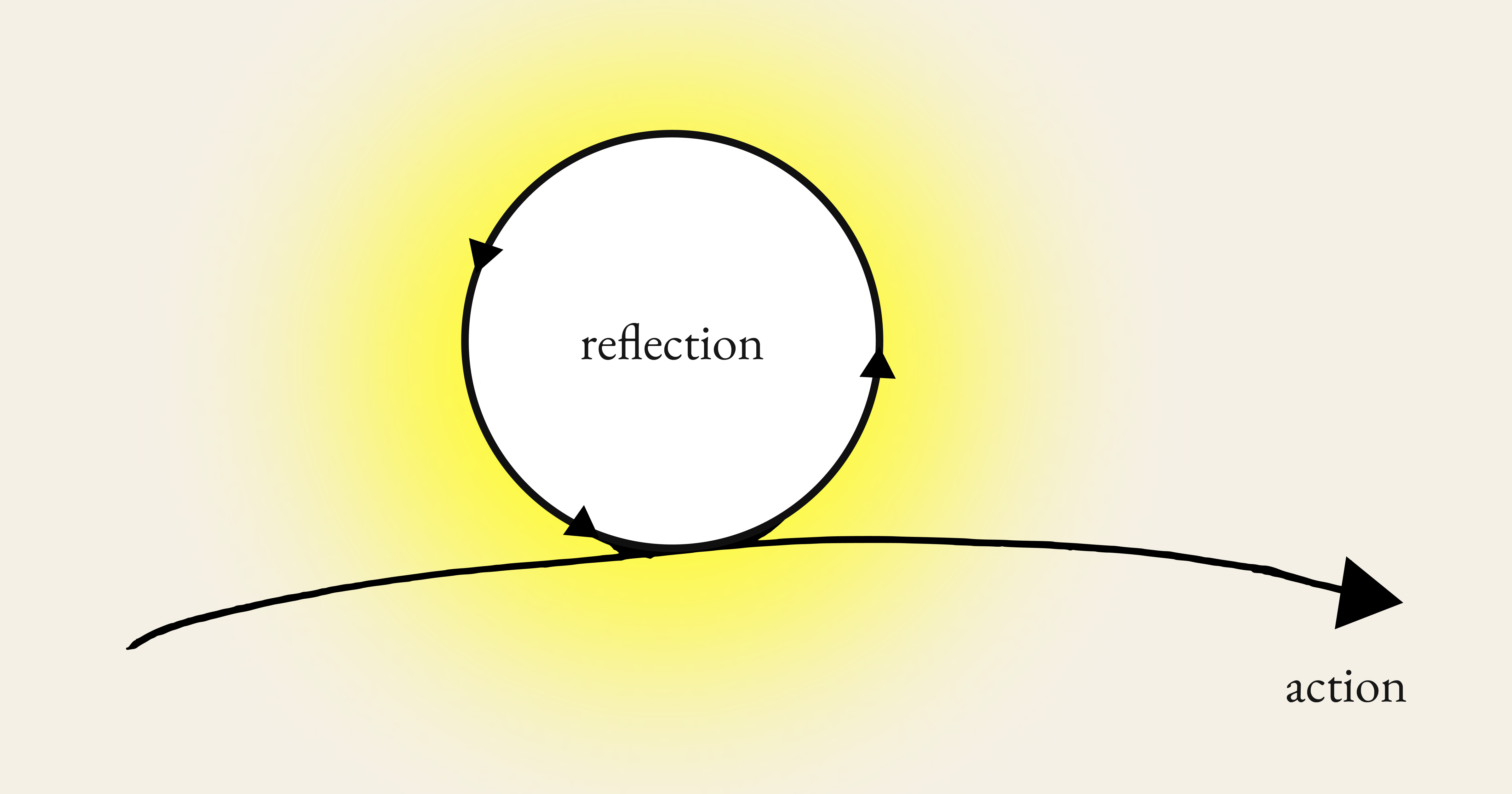
Today, I turn reflection into a contract with myself. Not “I should write more.” Instead: “Tomorrow at 7 am, I walk for 30 minutes listening to this audiobook and then take notes for my letter.”
As I practice, my commitments (and decisions) become bigger. Last year in February, I wrote a contract to myself to commit to building my brand, Hyper Real Love, for a year. I kept it on my desk to practice saying “no” to other well-paying job opportunities. My commitment to not take a job, but create my own, was a dare to plunge into uncertainty. But this decision was the best I could have made, because it was a conscious step to experience and overcome what was holding me back in my work, relationships & mind.
This is when the term practicing change was born for me.
And in this letter, I will explain to you how to practice it.
The best time you’ll ever have to start practicing change is now. Because the more you wait, the more comfort you will find in rereading the same story in your head and the harder it will become to introduce a new chapter.
I’ve been there, I’ve caught myself looking to others. I accepted the job that made me stay comfortable, I scrolled on social media to look at other people’s success. I looked outside and waited for something to change. It was self-sabotage. But once I saw reality as a mirror for my desires, I started seeing opportunities for change and claimed them.
In this letter, I dedicate myself to sharing with you how you can claim your opportunities too, step-by-step, through the art of reflection. This letter is your wake-up call to start with a small, specific change and rebuild your self-trust. It contains an extensive overview of how to practice change.
If you want to fast-track a connection to yourself, look inwardly. Stop relying on scrolling on social media to wait for someone else to tell you what to do. Because if you don’t make a decision, someone else is going to make it for you.
This letter is for you if:
You are ready to turn reflection into action through small conscious change
You already reflect, but feel stuck in loops
You want to rebuild self-trust and rewire your thought patterns
This letter is even more for you if:
You think things stay the same
You outsource responsibility for your own life
You find comfort in your fears and call them your reality
The Reframe: Reflection as Feedback Loop, Not Destination
The Taoist masters knew this:
“The perfect man employs his mind as a mirror”
(The book of Chuang Tzu, Chapter 7, ps: I remember reading this standing at Central Park in the rain).
But the mirror’s purpose is not to admire the reflection. It is to see clearly and then move. You are the observer and you can choose to participate.
Here are three of the most compelling ideas I came up with. This is the extensive guide I created:
I - a checklist to understand what is good reflection vs. bad reflection,
II - a step-by-step system on how to make your reflection useful and turn it into action,
III - forms of reflection to start practicing change today and create your own ritual.
I also included a full 16-page PDF on how I made my 2025 year reflection useful. One of them was to start acknowledging the value of my writing and share it with others.
Let’s start practicing change!
I – Good Reflection vs. Bad Reflection (The Checklist)
I like this quote by Munger: “There is an old two-part rule that often works wonders in business, science, and elsewhere: (1) Take a simple, basic idea and (2) Take it very seriously”. So let’s start with a simple exercise to differentiate between good and bad reflection.
